
Dominick’s Fight to Keep Thomas Safe
I Know This Much Is TrueThis thread follows Dominick from the shock of Thomas’s self-amputation through a struggle to protect him from institutional confinement, culminating in Dominick’s recognition that his promise cannot give him control over his brother’s fate.
increasing Bearing strength in each event
 decreasing
Bearing strength in each eventdecreasingThe Library Sacrifice
The Library Sacrifice
A public crisis
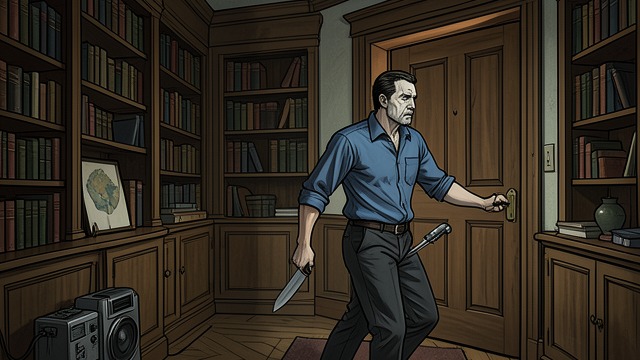
On October 12, 1990, Thomas enters the public library in Three Rivers, Connecticut, carrying a ceremonial knife and believing that a bodily sacrifice can stop the coming war. He interprets scripture as a command to cut off his right hand, turning private delusion into a public act that shocks the town and draws national attention.
Dominick learns what happened through the emergency response and the news coverage. He is Thomas’s identical twin, but he has spent years insisting on the distance between them. Now that distance is tested by an act he cannot ignore or explain away.
A consequential choice
At the hospital, Thomas refuses reattachment. The surgeon gives Dominick the decision because Thomas’s psychiatric state makes him unable to make a reliable medical choice. Dominick hears his brother insist that control over his own body is part of the sacrifice, and he lets that insistence guide him.
Dominick refuses the operation, despite the uncertain odds and the permanent disability it will leave. His choice protects Thomas’s stated autonomy, but it also becomes a source of guilt that he will revisit whenever he sees the damaged arm or wonders whether he should have intervened differently.
The Transfer to Hatch
The Transfer to Hatch
From hospital care to confinement
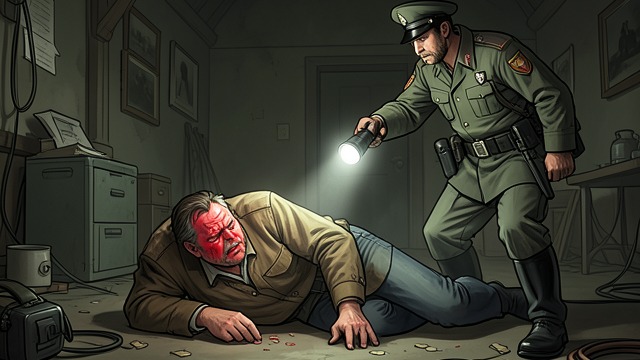
After surgery, Thomas is held for a mandatory observation period and then transferred under police escort to Hatch Forensic Institute. Dominick expects his brother to return to Settle, where Thomas has received treatment and held a small job. Instead, the officers follow orders to take him to a maximum-security facility.
Dominick argues with the escorts, tries to change the destination, and believes a simple phone call to Thomas’s doctor will resolve the mix-up. The transfer is not a clerical error, however. Thomas has been reassigned, and the institution will not let Dominick override its procedure.
The limits of protection
At Hatch’s security station, staff restrain, search, and process Thomas. He is frightened, unable to use familiar routines to calm himself, and distressed when his belongings—including his Bible—are taken away. Dominick interprets the procedures as a threat and becomes increasingly combative as he tries to stay beside his brother.
When Dominick intervenes during the intake, a guard knees him in the groin and forces him to the floor. The injury makes the institution’s power physical and immediate: Dominick can protest, but he cannot protect Thomas simply by wanting to. The failed attempt to prevent the transfer begins his campaign to understand how long Thomas may be held.
A Year Before the Review Board
A Year Before the Review Board
Learning the rules
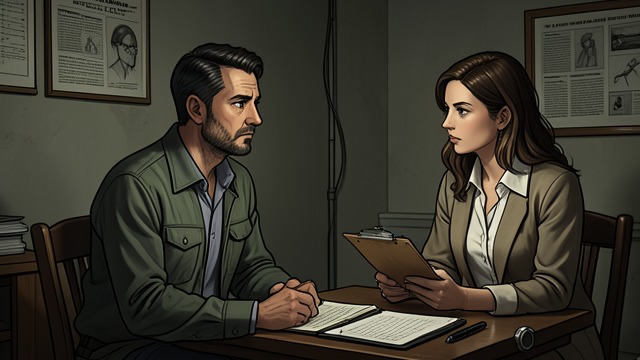
After the transfer, Dominick meets Lisa Sheffer, the social worker assigned to Thomas. She explains the emergency hold, the evaluation process, and the possibility that the Psychiatric Security Review Board could commit Thomas to Hatch for a year. She also warns that his visitors must be cleared, leaving Dominick unable to see him in person for a period of time.
Dominick resists every explanation that makes the transfer sound reasonable. He considers Thomas a frightened, nonviolent man who belongs in a less restrictive setting. Sheffer acknowledges that Hatch is difficult, but argues that the system is responding to both Thomas’s serious illness and the public alarm surrounding the library incident.
A fragile alliance
As Dominick’s first anger subsides, Sheffer becomes a practical ally. She describes the daily routine, keeps him informed, and helps him understand the institutional and political forces shaping the case. Dr. Patel begins treating Thomas and considers how his medication and paranoid symptoms may affect his behavior.
Dominick still hopes he can get Thomas out immediately, but the legal timeline is becoming clear. Observation, evaluation, and review take precedence over the brother’s demand for a quick return to Settle. His task shifts from reversing the admission at once to preparing for the hearing and making sure Thomas is not abandoned inside the process.
The Failed Hearing
The Failed Hearing
A plan disrupted
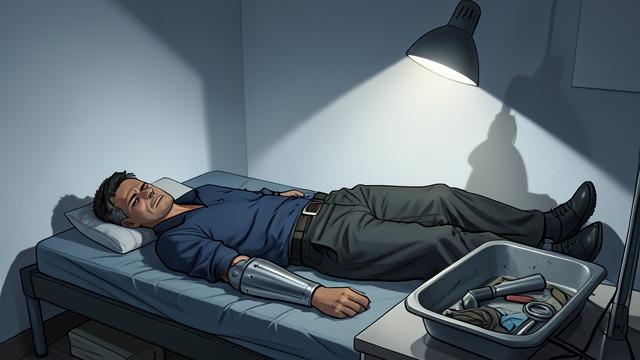
On the morning of the Review Board hearing, Dominick is injured in a fall from the roof of Henry Rood’s house. His truck is wrecked, he undergoes emergency surgery, and he is kept in the hospital while the Board proceeds without him. He had intended to speak for Thomas, and his absence feels to him like another failure of his promise to Ma.
The Board hears Thomas describe his amputation as obedience to God and say he would follow divine commands even if they involved harming someone. Thomas’s account confirms the clinicians’ concern that he remains dangerously governed by delusion. The Board votes unanimously to retain him at Hatch for a year.
The cost of missing the room
Dominick learns of the decision after waking from surgery and pain medication. He has not been able to influence the hearing, and he resents himself for the accident as though he had chosen to leave Thomas alone. His fear for Thomas becomes inseparable from his injuries, his relationship crisis with Joy, and the collapse of his working life.
The year-long commitment is painful news, but it also forces Dominick to see the limits of his influence. He cannot prepare Thomas to give the answer the Board wants, control the staff, or undo the hospitalization. His resolve to keep fighting remains, but the fantasy that vigilance alone can guarantee Thomas’s safety begins to weaken.
The Unfinished Promise
The Unfinished Promise
A family member, not a controller
Dominick visits Thomas after his security clearance comes through and watches him struggle with surveillance, teasing, and the regimented life at Hatch. During a later meeting, Thomas says staff members are abusing him and describes persecutors from his delusional world. Dominick cannot tell how much reflects actual danger, how much is illness, or how to protect his brother without taking away his choices.
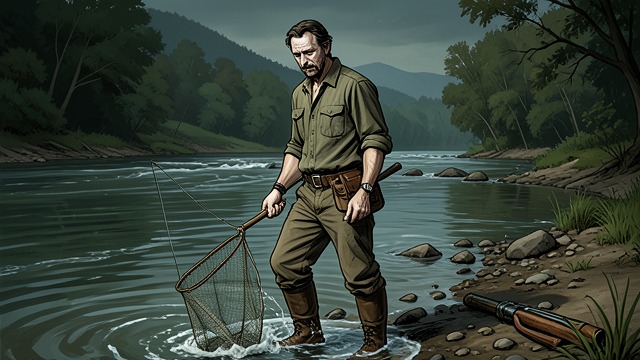
The Review Board retains Thomas after the hearing, and Dominick is injured in the fall that keeps him away. When Thomas is briefly released to Hope House, he disappears during the night and is found drowned in the Sachem River. Dominick arrives after the search and has to live with the permanent fact that he could not keep Thomas safe.
From guilt to mourning
For a time, Dominick treats the promise he made to Ma as a command to manage every crisis in Thomas’s life. After Thomas’s death, his certainty that he could have prevented the outcome gives way to a more painful understanding: love and responsibility do not confer control over another person’s illness or decisions.
Dominick continues therapy, confronts the family history he has avoided, and eventually returns to the river as a place of memory rather than a place where he can reverse the past. He remains connected to Thomas, but begins to imagine a life that is not defined solely by guarding his twin. His promise cannot be fulfilled as protection from every harm; it survives as an obligation to remember Thomas honestly and to keep living.
October 12, 1990
The first days after the library incident
Late October 1990, during the first fifteen-day hold
October 31, 1990, after Dominick’s accident
The months after Thomas’s commitment, ending after his death
